Montjuic
The Shadow of the WindMontjuic is both a physical landmark in Barcelona and a recurring site of memory in Daniel Sempere’s story. Its cemetery holds the childhood scene through which Daniel first encounters death and his father’s grief; later, a hidden crypt beneath the Aldaya mansion revives that memory and reveals the fate of Penelope and David Aldaya. The hill’s associations with burial and wartime violence make it a place where private loss and suppressed history converge.
Setting and remembered burial
In a recollection triggered by a staircase beneath the Aldaya mansion, Daniel remembers a rainy afternoon on Montjuic’s eastern slope. He sees a cemetery of mausoleums, crosses, and carved grave figures, while about twenty adults gather around a grey coffin. His father holds his hand tightly as the coffin is lowered into a marble tomb. Daniel remembers hearing his mother’s voice as if it were calling from inside, and asking his father to loosen his grip. The memory culminates in the smell of earth, ash, and rain, which he associates with emptiness and death.
The recollection explains why the smell of damp earth at the mansion’s hidden staircase feels familiar before Daniel can identify its source. The discovery does not simply lead him into another concealed room: it returns him to the childhood burial he could not understand at the time. Montjuic thus enters the plot through memory, its cemetery serving as the original setting for a grief that Daniel has carried without fully comprehending.
A location shaped by silence
Daniel’s father later tells him that before her death, Daniel’s mother made him promise never to speak to his son about the war or allow him to remember what had happened. His father admits uncertainty about having kept that promise. The explanation places Daniel’s incomplete childhood memory within a deliberate family silence: what he remembers is vivid, but the history that would make sense of it has been withheld.
Montjuic also figures in the wider aftermath of war. In the account Nuria Monfort gives Daniel, the end of the conflict brings no clean transition to peace; violence and secrecy continue, while people fall silent about what they have seen and done. She recalls reports that Fumero was executing former allies in the cells of Montjuic Castle. The hill’s burial associations therefore extend beyond Daniel’s family memory to a public landscape marked by political violence and the fear of testimony.
The crypt and the Aldaya dead
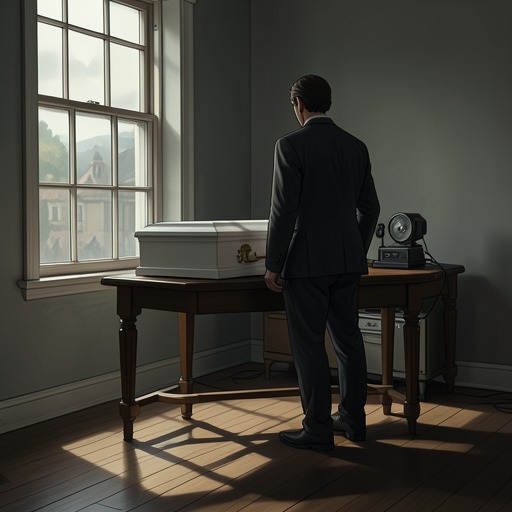
Years after the childhood funeral, Daniel and Bea search beneath the Aldaya mansion. In a hidden chapel, Daniel finds old dressmaking forms bearing the names Isabel, Eugenia, and Penelope. A further staircase leads to a stone crypt, where two white coffins lie on a marble slab. Dust obscures their inscriptions until Daniel brushes it from the larger coffin and reads Penelope Aldaya’s name and the dates 1902–1919.
Later, Daniel returns to the crypt with Julian. The pair of graves is now legible: Penelope Aldaya, dated 1902–1919, and David Aldaya, dated 1919. The discovery confirms that Penelope and her child were buried together, bringing the concealed family history into the open. The crypt’s arrangement recalls Daniel’s childhood image of a coffin being lowered into a tomb, but this time he can read the names and dates that the earlier scene left beyond his understanding.
Changing meanings of place
Montjuic links several forms of burial in the novel: Daniel’s mother’s funeral, the deaths concealed in the Aldaya crypt, and the violence associated with the castle during the war. These are distinct histories, but their recurrence around the hill gives the landscape an accumulating weight. What first appears to Daniel as an isolated childhood memory becomes part of a larger pattern in which deaths are hidden, names are obscured, and knowledge arrives only after long delay.
The novel later shows the Aldaya mansion restored and repurposed: its garden becomes a car park, its old library a boardroom, and the room where Daniel and Bea conceived Julian a bathroom. That transformation stands in contrast to the persistence of Montjuic’s burial ground in Daniel’s memory. Buildings can be renovated and their former uses erased, but the remembered funeral—and the history it withheld—continues to shape how he understands the city.